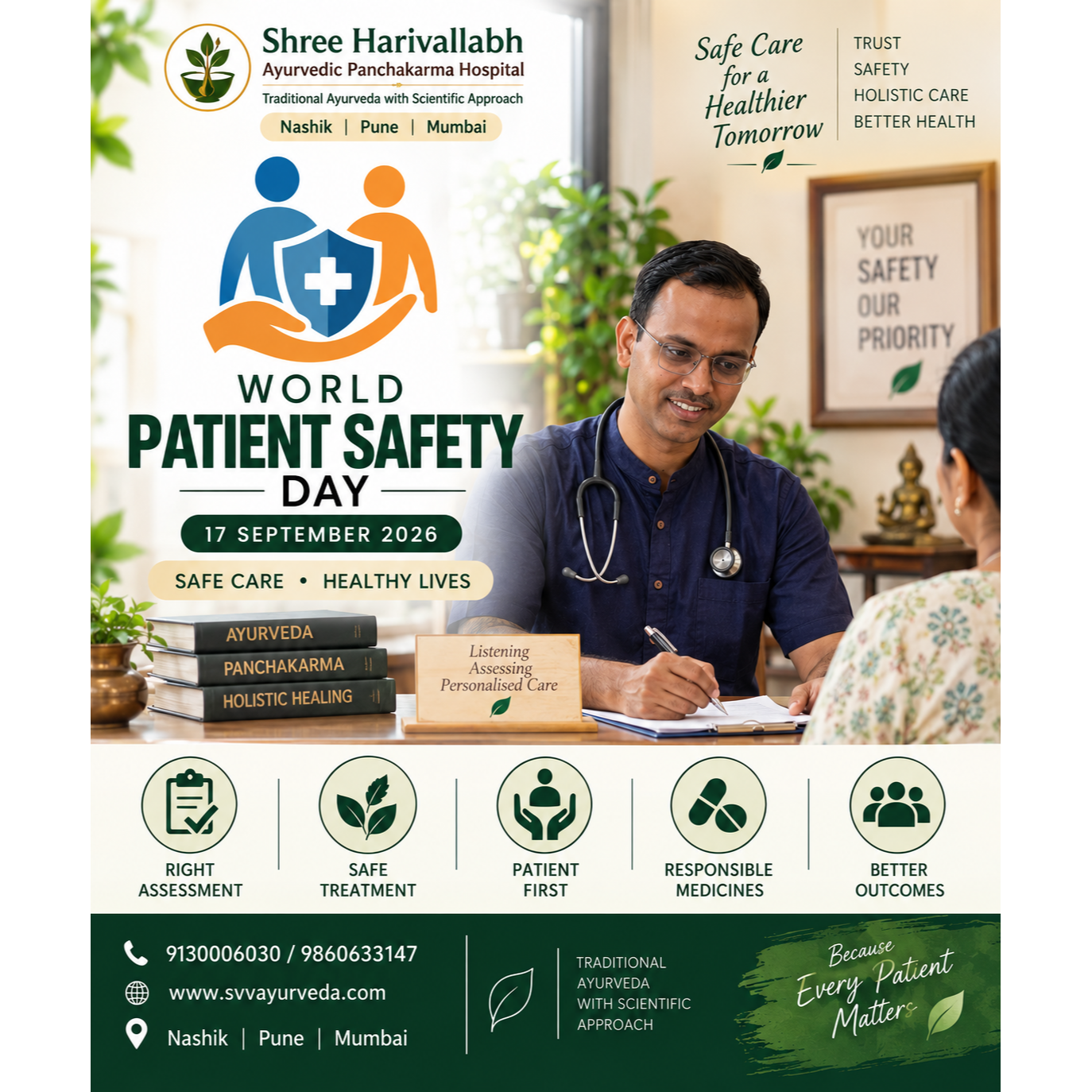
World Patient Safety Day is observed every year on 17 September. The 2026 theme focuses on safe care for people living with noncommunicable diseases and highlights the importance of safety throughout prevention, diagnosis, treatment, long-term management and self-care.
Patient safety is not limited to one department, one treatment or one type of healthcare system. It is an essential part of every responsible healthcare practice.
At Shree Harivallabh Ayurvedic Panchakarma Hospital, patient safety is an important part of our approach to Ayurveda and Panchakarma.
What Does Patient Safety Mean in Ayurveda?
Safe Ayurvedic treatment begins with proper patient assessment.
Before recommending an Ayurvedic medicine, Panchakarma procedure or external therapy, the physician needs to consider the patient’s age, Prakriti, Vikriti, symptoms, disease stage, strength, digestion, medications, medical history and other relevant factors.
The same treatment is not appropriate for every patient.
This is particularly important in Panchakarma. Vamana, Virechana, Basti, Nasya and other procedures require appropriate patient selection, preparation, supervision and follow-up.
Traditional Ayurveda with Scientific Approach
Ayurveda is a traditional medical system with its own principles of diagnosis and treatment. A modern scientific approach adds systematic documentation, appropriate investigations, safety monitoring and responsible clinical decision-making.
At Shree Harivallabh Ayurvedic Panchakarma Hospital, our philosophy is to respect classical Ayurvedic principles while maintaining a structured approach to patient care.
This includes:
Detailed consultation
Appropriate clinical assessment
Individualised treatment planning
Review of current medicines and relevant medical history
Appropriate investigations when required
Monitoring during procedures
Clear patient instructions
Follow-up and reassessment
Patient education
Medication Safety
Medication safety is an important component of patient safety.
Patients should inform their physician about all medicines, supplements and other treatments they are currently taking.
Patients should not independently increase, decrease or discontinue prescribed medicines without appropriate medical advice.
Ayurvedic medicines are also medicines and should be used responsibly. Natural origin does not automatically mean that a medicine is suitable for every individual.
Correct identification, appropriate formulation, quality manufacturing, dosage and clinical supervision are important.
Safety During Panchakarma
Panchakarma is a specialised branch of Ayurveda. Procedures such as Basti, Vamana and Virechana should not be performed simply because they are popular or recommended online.
Proper assessment is necessary.
The treatment plan may vary according to the patient’s condition, strength, season, digestive status, age and other factors.
Pre-procedure preparation and post-procedure care can also be important.
Patient safety therefore begins before the procedure and continues after it.
Long-Term Care and Noncommunicable Diseases
Diabetes, hypertension, cardiovascular disease and other chronic conditions often require long-term care.
Patients may interact with several healthcare professionals and may use multiple medicines. Communication between the patient and healthcare team becomes especially important.
Patients should maintain records of diagnoses, reports and medicines and share relevant information during consultations.
Ayurveda can contribute to lifestyle and wellbeing management in appropriately selected patients, but established chronic diseases require appropriate medical monitoring.
Patient as a Partner
Patient safety improves when patients actively participate in their own healthcare.
Ask questions.
Understand the treatment.
Inform the doctor about existing medicines.
Share previous reports.
Follow instructions.
Report unexpected symptoms promptly.
Attend follow-up appointments.
Do not self-medicate based only on internet information.
This patient-centred approach is an important part of safe healthcare.
Our Commitment
Shree Harivallabh Ayurvedic Panchakarma Hospital follows the principle that traditional medicine should be practised responsibly.
Our vision is not simply to provide Ayurveda treatment, but to create a healthcare environment where classical Ayurvedic knowledge, clinical assessment, patient education and scientific understanding work together.
Traditional Ayurveda with Scientific Approach
This approach aims to make healthcare more systematic, personalised and patient-centred.
For Ayurvedic consultation, Panchakarma assessment and personalised treatment planning, patients can consult our Ayurvedic physicians at Shree Harivallabh Ayurvedic Panchakarma Hospital.
Nashik | Pune | Mumbai
Appointment: 9130006030 / 9860633147
www.svvayurveda.com
World Patient Safety Day 2026, Safe care for life, patient safety Ayurved